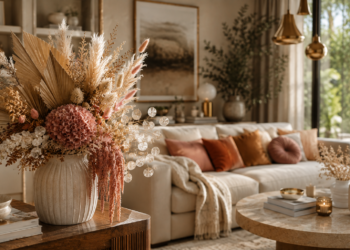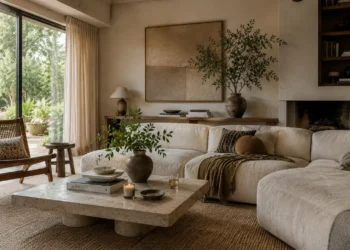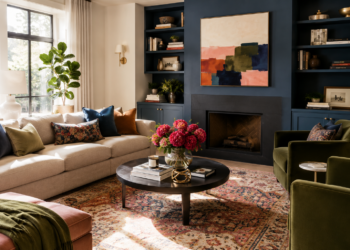

You know an organic modern living room the second you see it. Curved sofa. Jute rug underfoot. A cluster of unglazed ceramics on the coffee table. Linen everywhere, in exactly the right shade of oatmeal.
But here’s what most people never figure out: knowing the ingredients isn’t the same as knowing the recipe. That’s why so many attempts at this look end up feeling like a Pinterest board someone bought all at once—technically correct, but somehow flat. Nothing wrong, nothing surprising.
Designers don’t build a room by shopping a mood board. They build it in a sequence: layout first, then a focal point, then proportion, then light, then material, then the small styling choices that make a space feel lived-in instead of staged. Once you understand that order, the “organic modern” formula stops being a vibe you’re chasing and becomes a process you can actually repeat in your own home.
Here’s how it works, step by step.
What Makes a Room “Organic Modern” (Not Just Neutral)
Organic modern sits at the intersection of two ideas that shouldn’t work together but do: the restraint of modern design and the imperfection of natural materials. Clean lines, but nothing sterile. Neutral palette, but nothing flat.
It’s easy to confuse this with modern farmhouse (too much shiplap and black hardware) or generic minimalism (too cold, too empty). Organic modern has warmth built into its bones—curved silhouettes instead of hard angles, matte textures instead of glossy ones, and a materials palette pulled from the outdoors: wood, stone, clay, linen, wool, rattan.
The emotional target is specific: a room should feel calm without feeling unfinished, and personal without feeling cluttered. That balance is the whole game, and it’s decided at the layout stage—long before anyone thinks about throw pillows.
Step 1: Start With the Layout, Not the Furniture
This is where most DIY attempts go wrong immediately. People start with a sofa they love and build outward. Designers do the opposite—they study the room first.
Find the room’s natural anchor. Every living room has one architectural feature that’s already doing visual work: a window with good light, a fireplace, a run of built-ins. Organic modern design doesn’t fight that feature. It builds toward it.
Map traffic flow before placing anything. Walk the room the way people actually will—from the entry, to the kitchen, past the hallway. Furniture should never block that natural path. This sounds obvious, but it’s the single most common reason a “correctly decorated” room still feels awkward to actually live in.
Design for conversation, not just a TV. Organic modern rooms favor seating arrangements that face inward toward each other, with the television as a secondary consideration rather than the room’s whole reason for existing. A sofa and two chairs angled toward a coffee table reads as intentional. A sofa pushed against the wall facing a screen reads as furniture that happened to a room.
Avoid the “everything against the wall” trap. Pulling furniture even a few inches off the walls and letting pieces float creates the layered, considered feeling that defines this style. Perimeter furniture is the fastest way to make a room feel like a waiting area.
Step 2: Choose Your Focal Point
Once the layout is mapped, designers pick one—and only one—dominant visual anchor. Everything else in the room supports it.
Common focal point choices in organic modern spaces:
- A curved sofa, especially in a bouclé or performance linen, positioned as the room’s centerpiece
- A sculptural light fixture—a woven pendant, a plaster piece, something with visual weight
- An art moment, usually oversized and abstract, in warm or earthy tones
- A textured accent wall—limewash, venetian plaster, or vertical wood slats
The mistake to avoid is having three or four “special” elements competing for attention. Organic modern relies on restraint. Pick the one thing the eye should land on first, then let the rest of the room quietly reinforce it rather than compete with it.
Step 3: Get Furniture Proportions Right
Proportion is where organic modern rooms either feel expensive or feel off, and it has almost nothing to do with budget.
Scale to the room, not to caution. A common instinct is to buy a smaller sofa “to be safe.” In practice, an appropriately large, low-profile curved sofa almost always reads better than a too-small one floating in too much space. Undersized furniture is one of the fastest ways to make a nice room feel unfinished.
Mix rounded and straight forms. All-curved furniture starts to feel indecisive. The strongest organic modern rooms pair a curved sofa or arched mirror with one or two straight-lined pieces—a rectangular console, a linear coffee table—so the eye has contrast to rest on.
Vary height for rhythm. Low sofas paired with a taller floor lamp, an oversized plant, or a tall woven basket creates the visual rhythm that keeps a neutral room from feeling monotone. Without height variation, even beautifully chosen pieces can feel like they’re sitting in a single flat plane.
Let negative space do its job. Empty floor space isn’t a gap to fill—it’s part of the design. Organic modern rooms breathe. Resist the instinct to add “just one more” piece to a room that already has enough visual information.
Step 4: Layer Your Lighting
This is the step most people skip entirely, and it’s often the difference between a room that looks styled and one that looks like it was never quite finished.
Designers work in three lighting layers:
- Ambient light — the general glow of the room, often from an overhead fixture on a dimmer rather than harsh, even recessed lighting
- Task light — reading lamps, a floor lamp beside a favorite chair, something with a functional job
- Accent light — picture lights over art, a lamp lighting a bookshelf, small pools of warmth in the corners
Organic modern spaces lean toward warm-toned bulbs and sculptural fixtures—woven pendants, plaster table lamps, fixtures with visible natural texture—rather than sleek, cool-toned recessed lighting alone. A room lit only from above, evenly and coolly, will never feel organic modern no matter what furniture sits in it. The corners need their own small sources of warmth.
Step 5: Build the Material Palette
Here’s a simple formula designers use to keep an organic modern material palette cohesive instead of chaotic:
One stone or concrete texture (a side table, a fireplace surround, a plaster wall finish) + One warm wood tone (flooring, a console, exposed beams) + One woven natural fiber (a jute or sisal rug, rattan chairs, a woven pendant) + Soft textiles layered throughout (linen upholstery, a chunky wool throw, a bouclé accent chair)
For color, stay in warm neutral territory—sand, clay, oatmeal, warm white—with charcoal or deep sage used sparingly for grounding. The trap to avoid is “beige on beige on beige,” where everything is the right color family but nothing has texture to differentiate it. In organic modern design, contrast comes from texture, not from color. A smooth linen sofa next to a nubby wool rug next to a rough-hewn wood table does more visual work than three different colors ever could.
Step 6: Styling Details That Make It Feel Finished
The last 10% is what separates “nicely decorated” from “designed.” These are the small choices designers make at the very end:
- Style in odd numbers. Groupings of three on a shelf or coffee table (a stack of books, a ceramic vessel, one small object) read as more intentional than pairs.
- Include one imperfect or vintage piece. A flea-market side table, a chipped ceramic bowl, an inherited chair reupholstered in linen. One item that doesn’t look brand-new signals that the room was curated over time, not purchased in a single weekend.
- Use greenery as texture, not decoration. A large fiddle leaf fig or olive tree adds height and organic shape—it’s doing structural work in the room, not just filling a corner.
- Leave one sign of life. A stack of well-loved books, a tray of ceramics, a throw blanket slightly rumpled rather than perfectly folded. Rooms that look too perfect read as showrooms. Organic modern wants evidence that someone actually lives there.
Mistakes to Avoid
- Too much curve, no contrast. An all-rounded room without a single straight line starts to feel soft in a bad way—add at least one angular piece for balance.
- Flat, same-color materials. If everything is beige and nothing has texture, the room will feel unfinished no matter how expensive the pieces are.
- Skipping lighting layers. One overhead fixture is never enough. Corners need their own warmth.
- Getting scale wrong. A too-small sofa in a large room, or oversized furniture crammed into a small one, undoes every other good decision in the space.
Bringing It All Together
Organic modern isn’t a shopping list—it’s a sequence. Layout, then focal point, then proportion, then light, then material, then the small styling details that make a space feel like it belongs to someone. Work through those steps in order in your own living room, and the “look” stops being something you’re copying and becomes something you actually built.